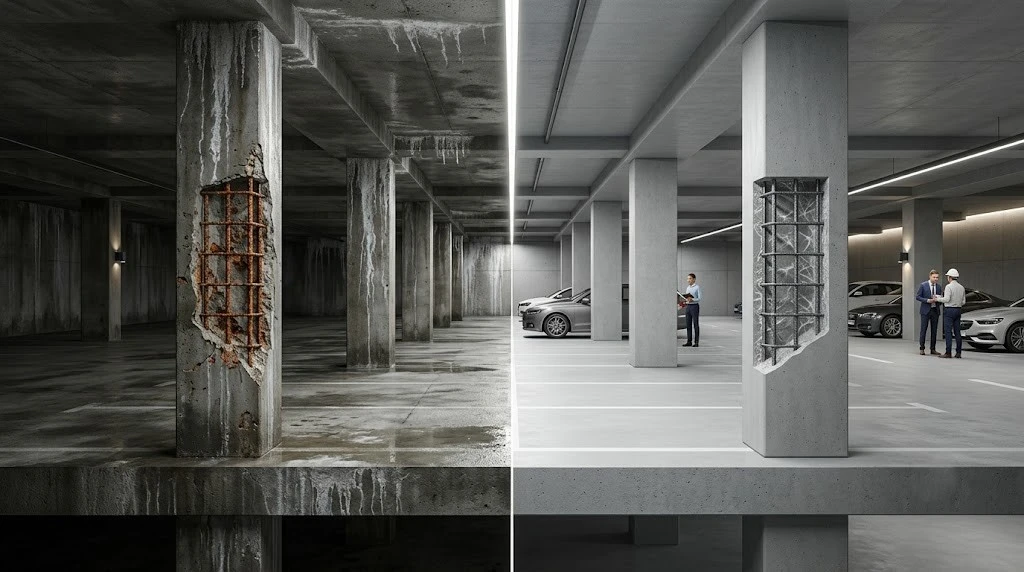
Elevator pits are naturally vulnerable to groundwater ingress. Being the lowest point within a building foundation, the lift pit often acts like a collection point for water. It is continuously exposed to hydrostatic pressure, changing groundwater levels, and structural stresses, making effective waterproofing essential.
This is where capillary crystalline waterproofing provides an engineered, permanent solution. Unlike barrier systems, crystalline technology transforms the concrete matrix itself into a water-tight, self-healing barrier.
This technical guide evaluates the precise micro-mechanisms, crystal sizing, chemical reactions, and application protocols required to successfully waterproof lift pits using crystalline technology.
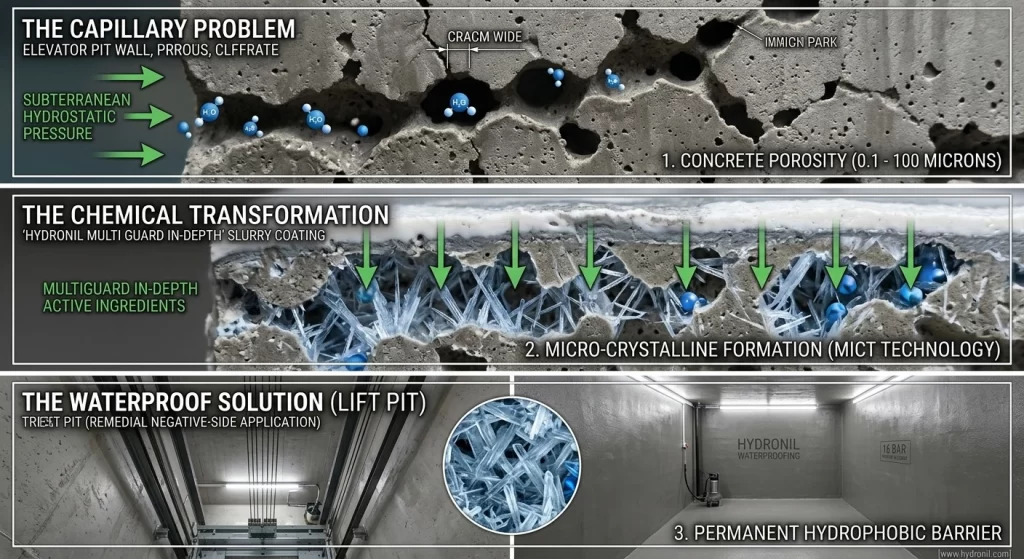
Concrete is naturally a porous, heterogeneous material. During the hydration and curing processes of standard Portland cement, the evaporation of excess mix water (water of convenience) leaves behind an intricate network of interconnected micro-cavities.
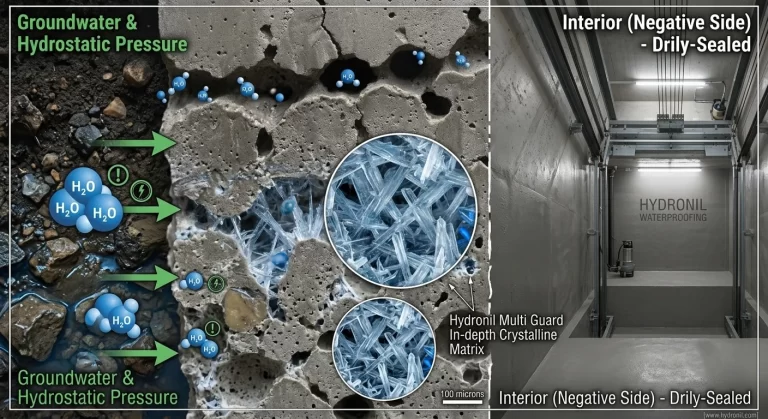
When groundwater surrounds a subterranean lift pit:
Crystalline waterproofing for Lift pit relies on chemical diffusion and reaction kinetics rather than surface adhesion. The formulation consists of ordinary Portland cement, specially graded silica sand, and proprietary, highly reactive catalytic chemicals.
When applied as a surface treatment (slurry) or introduced as an integral admixture, the active chemicals dissolve in water and begin moving through the concrete. Driven by a chemical concentration gradient, these active ingredients penetrate deep into the concrete through osmotic diffusion, where they react with moisture and unhydrated cement and cementitious particles.
Once inside the concrete pores, the active chemicals (Catalyst) initiate with unhydrated cement particles (including cementitious particals) and water, initiating the formation of insoluble crystalline structures.
Cement Particles + H₂O –> Calcium Silicate Hydrate (C-S-H) + Crystalline Structure
The resulting chemical precipitate is a non-soluble, dense, needle-shaped crystalline matrix. These micro-structures physically block the movement of liquid water while allowing the concrete to remain vapor-permeable (“breathable”), preventing osmotic blistering.
Understanding the spatial configuration of these crystals explains why they are uniquely suited for high-pressure elevator pits:
| Structural Voids | Typical Dimensional Scale | Crystalline Interception Capacity |
|---|---|---|
| Concrete Capillary Pores | 0.1 to 10 microns | Crystals completely choke the pore diameter, reducing permeability by up to 90%. |
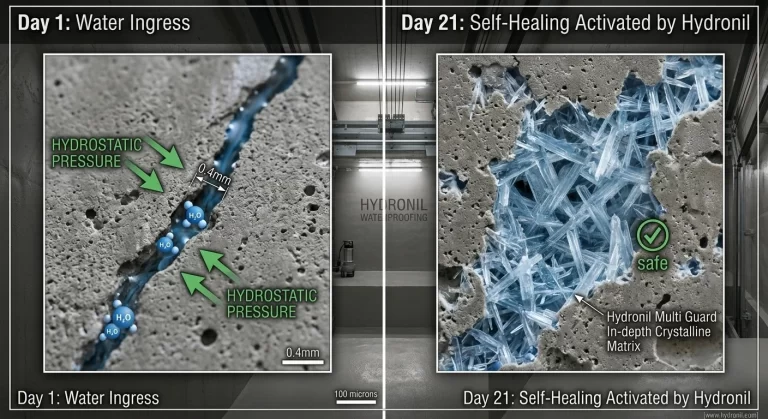
| Hairline Shrinkage Cracks | Up to 400–500 microns (0.4–0.5 mm) | Micro-needle crystal structures bridge the gap, enabling autogenous self-healing. |
| Individual Crystal Micro-Needles | Lengths vary depending on moisture availability | Continuous crystal growth restricts and eventually blocks the water pathway. |
The needle-shaped crystals are extremely small, allowing them to interlock and fill the concrete’s pores and capillaries. These crystals remain dormant within the concrete for the life of the structure. If new micro-cracks develop later due to structural movement, the presence of water reactivates the chemicals, forming new crystals that seal the cracks automatically.
In new construction, crystalline admixtures are typically incorporated directly into the batch plant mix (Positive-Side/Integral Waterproofing). However, for remedial intervention in existing structures, external excavation is rarely feasible.
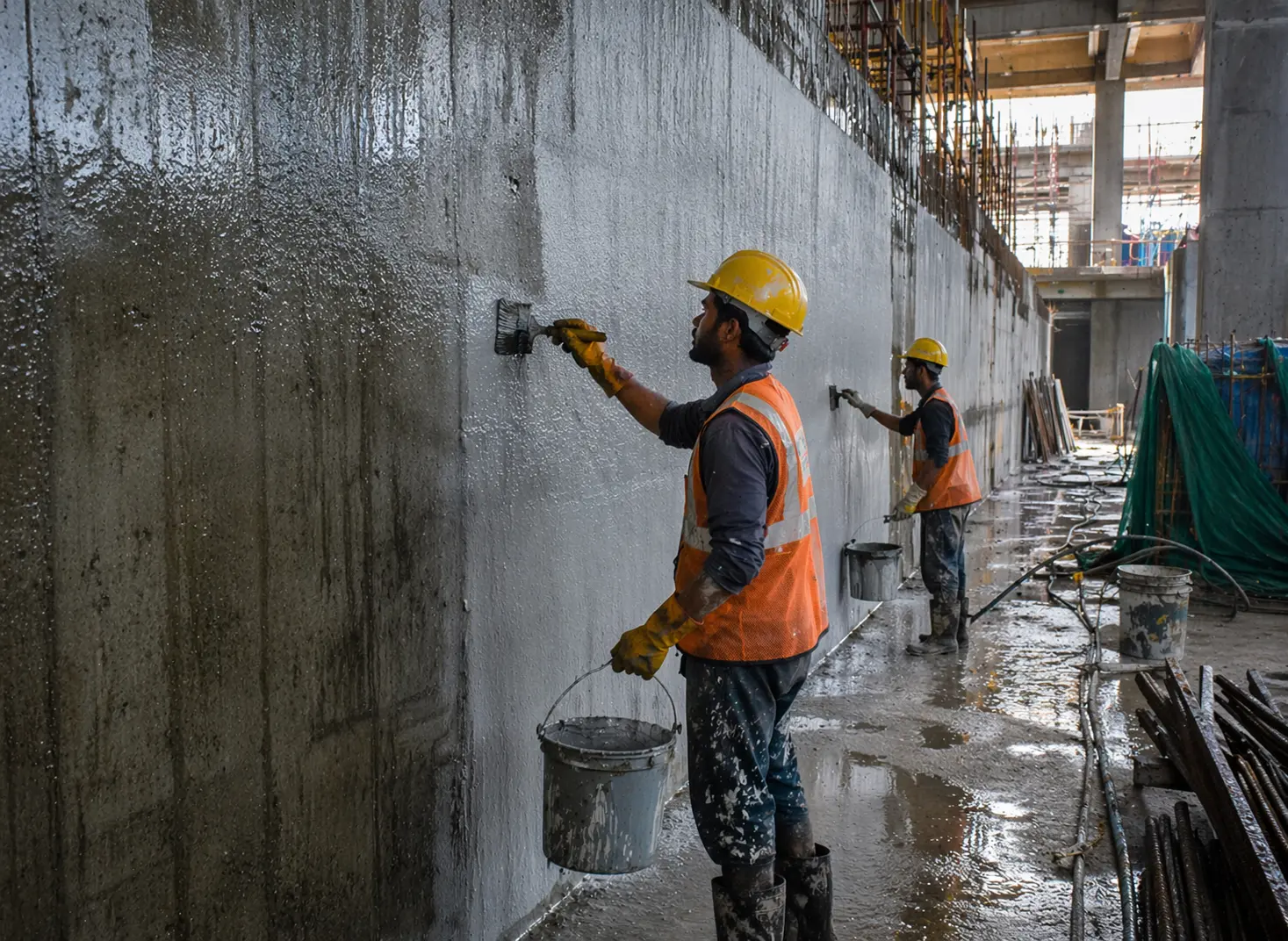
Crystalline systems excel in negative-side waterproofing (applied to the inside faces of the elevator pit walls and floor slab). Because the chemical mechanism relies on moisture to diffuse into the concrete substrate, the presence of incoming groundwater actually accelerates the osmotic migration of the active ingredients deep into the concrete wall.
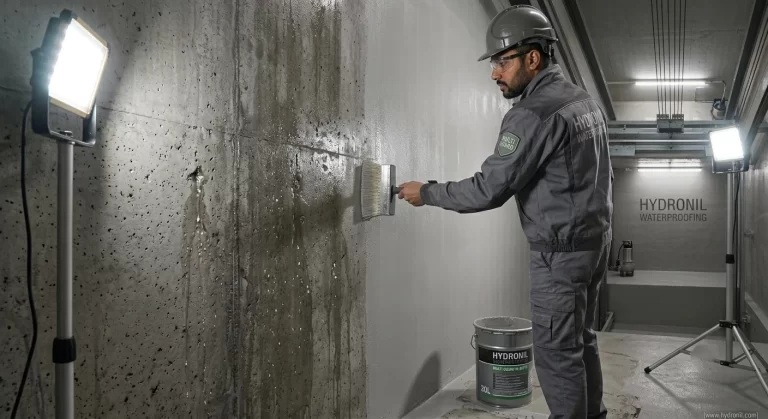
To successfully execute negative-side crystalline waterproofing for lift pit, a rigid multi-step engineering protocol must be enforced:
Mechanical profiling is mandatory. The concrete surface must be free of laitance, form-release oils, dirt, and existing epoxy or bituminous coatings.
Active water leaks under pressure must be stopped before applying the main crystalline waterproofing coating.
Dynamic movement cracks or construction joints must be treated as independent conduits.
Hydronil represents the pinnacle of advanced capillary crystalline waterproofing, engineered precisely to turn porous concrete into an active, impermeable defense mechanism.
The core of Hydronil’s performance lies in its proprietary product, Multiguard In-depth. Powered by Multiguard In-depth Crystalline Therapy (MICT) technology, this specialized formulation penetrates deep into the capillary network of the concrete structure. Rather than forming a temporary film on the surface, Multiguard In-depth drives its active catalytic chemistry through the concrete matrix via osmotic diffusion.
When applied to a lift pit, Multiguard In-depth continuously activates reaction with moisture and unhydrated cement to grow the sub-micron, needle-like crystals detailed in this guide. This deep-penetrating crystalline matrix completely chokes off the capillary tracts and automatically heals future hairline cracks up to 0.5 mm.
By eliminating water ingress at a molecular level, Hydronil guarantees a dry, safe, and maintenance-free environment, protecting critical elevator machinery and extending the lifespan of the entire infrastructure.
To explore complete technical data sheets, engineering specifications, or to consult with a structural waterproofing expert for your next project, visit the official website at www.hydronil.com.


Hydronil® delivers advanced crystalline waterproofing systems powered by MICT technology.
+91 70382 83666
info@hydronil.com